
How car recycling works: what happens to a junk car
Quick answer
A junk car is drained of fluids and hazardous parts, stripped of parts that can be resold, then crushed and shredded so its steel and other metals can be melted into new products. USGS reports that more than 13 million tons of steel a year is recycled from automobiles in North America, the equivalent of about 17 million cars, and the yard must report the car's VIN to the federal NMVTIS database.
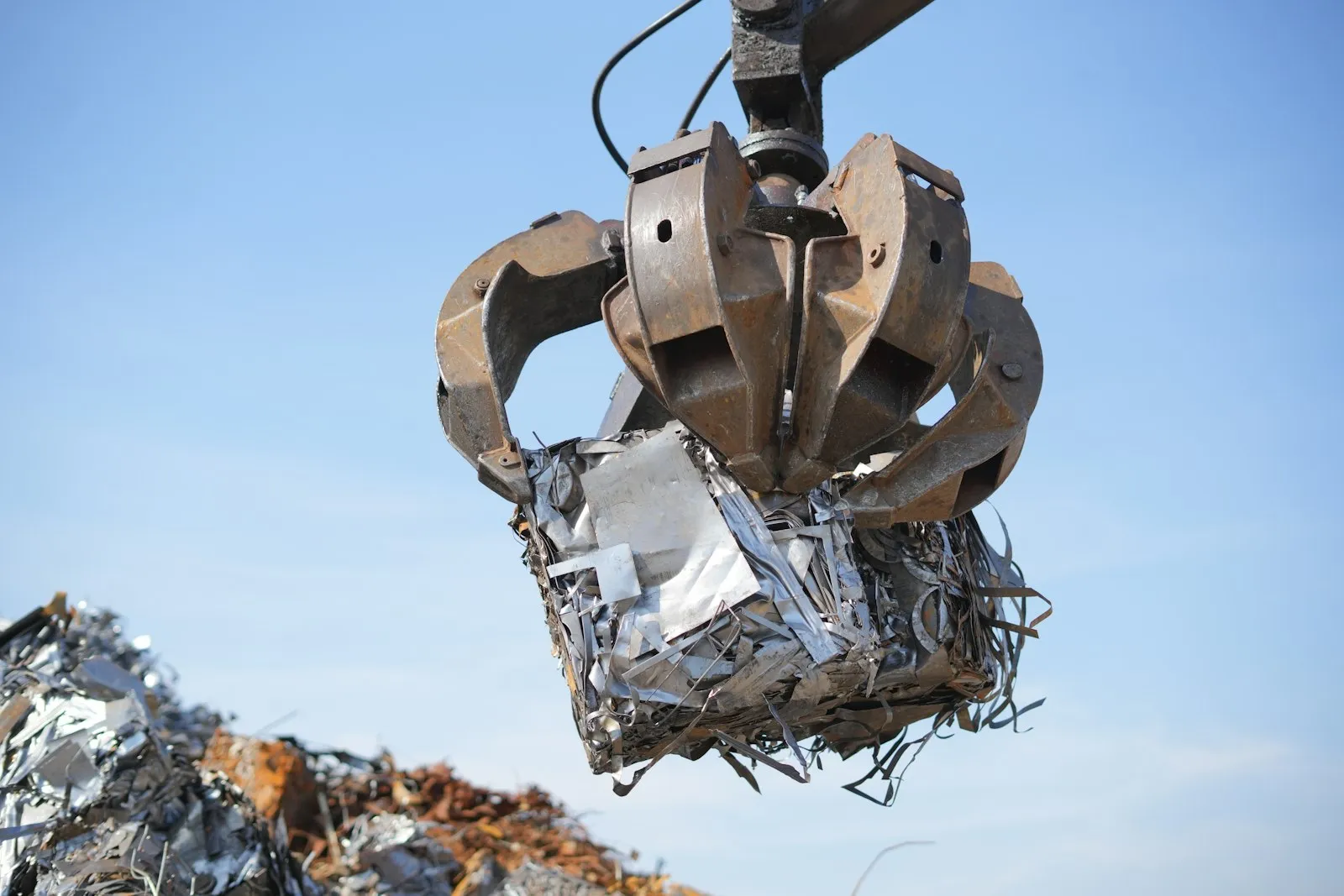
When you junk a car, it goes through a set order: paperwork, removing fluids and hazards, selling parts, crushing, shredding, and separating the metal. Almost all the steel ends up melted into new steel. U.S. Geological Survey data says recycling of automobiles is nearly 100% each year, and that automobiles are the primary source of old steel scrap in the United States.1
Car recycling at a glance
| Step | What happens | Where |
|---|---|---|
| 1. Intake and reporting | Title and ID checked; VIN reported to NMVTIS | Junkyard or auto recycler |
| 2. Depollution | Fuel, oil, coolant and other fluids drained; battery, refrigerant, mercury switches, tires and air bags handled | Junkyard or auto recycler |
| 3. Parts harvesting | Engines, transmissions, body panels, catalytic converters and other parts removed for resale or rebuilding | Full-service or self-service yard |
| 4. Crushing | Stripped car flattened or baled for transport | Yard, often with a mobile crusher |
| 5. Shredding | Hulk torn into small pieces | Shredder facility |
| 6. Metal recovery | Magnets and sorting systems separate steel from aluminum, copper and other metals | Shredder facility |
| 7. Melting | Steel goes to mills, mostly as feedstock for new steel | Steel mill or foundry |
| 8. Residue | Plastics, rubber, glass, foam and fabric left over | Mostly landfill |
The scale is large. USGS reports that more than 13 million tons of steel per year is recycled from automobiles, the equivalent of approximately 17 million cars, from more than 280 car shredders in North America.1 The Automotive Recyclers Association says the professional auto recycling industry recycles over 4 million motor vehicles a year in the U.S. and Canada, and employs over 140,000 people at more than 9,000 locations in the United States.2 (The two figures measure different things: USGS counts steel recycled through car shredders, while ARA describes its professional recycling segment.)
Step 1: Intake, title check and NMVTIS reporting
Before a yard touches the car, it checks the paperwork. Yards generally ask for a title or other proof of ownership, and the rules vary by state. See junk car laws by state and our title guide.
Then comes federal reporting. Junk and salvage yards must give the National Motor Vehicle Title Information System (NMVTIS) a monthly inventory of every junk or salvage automobile they obtained in the prior month.3 Each report includes:3
- The yard’s name, address and contact information
- The VIN
- The date the vehicle was obtained
- Who it was obtained from
- Whether it was crushed or disposed of, sold or used for other purposes, who received it, and whether it is intended for export
Yards that handle fewer than five salvage, junk or total-loss vehicles a year don’t have to report.3 Scrap metal processors and shredders that receive cars whose VINs can’t be read generally don’t have to report them if the supplier already did. When they can’t confirm that, they must report based on a visual inspection or the title documents.3 The federal law behind NMVTIS sets a civil penalty of up to $1,000 for each violation,4 which the Justice Department has adjusted for inflation to a maximum of $2,111 for penalties assessed after July 3, 2025.5
This reporting protects you and the next buyer. Once a car is reported as junk or crushed, it’s much harder for someone to retitle it, clone its VIN or sell it as a working car. Read more in NMVTIS junk and salvage reporting. Some states also issue a certificate of destruction or similar document once a car is scrapped.
Step 2: Depollution (removing fluids and hazards)
A car has fluids and parts that can harm soil, water and air if they go into a crusher or shredder. Removing them is the first physical step, and several are covered by federal rules.
Fluids
Recyclers drain gasoline and diesel, engine oil, transmission fluid, coolant, brake fluid, power-steering fluid and washer fluid. Much of it is reused or recycled. ARA estimates that each year the industry collects and reuses or recycles about 8 million gallons of gasoline and diesel fuel, 24 million gallons of motor oil, 8 million gallons of engine coolant and 5 million gallons of windshield washer fluid.2 (ARA’s figures are undated industry estimates.)
Used oil gets special care. EPA says used oil from one oil change can contaminate one million gallons of fresh water.6 Recycled oil has real value: one gallon of used motor oil provides the same 2.5 quarts of lubricating oil as 42 gallons of crude oil.6 Oil filters are drained completely and then recycled; their steel can be reused by steel producers.6
Air-conditioning refrigerant
The refrigerant in a car’s air conditioner is regulated under the Clean Air Act. Section 609 covers servicing: anyone who repairs or services a motor vehicle A/C system for payment must be trained and certified by an EPA-approved program and use certified refrigerant handling equipment.7
When a car is scrapped, EPA’s safe-disposal rules apply. Car A/C systems typically enter the waste stream with their refrigerant charge intact, and the final person in the disposal chain, such as a scrap metal recycler, is responsible for making sure the refrigerant is recovered before final disposal.8 If refrigerant was removed earlier, the recycler must get a signed statement with the name and address of whoever recovered it and the recovery date. EPA does not accept a sticker as verification.8 Recovery equipment must meet the same performance standards as equipment used for servicing.8
Mercury switches
Some older vehicles have small mercury switches, each about the size of an acorn, in convenience-light switches, anti-lock brake system switches and active ride control systems.9 If a car is melted with the switch still in it, mercury can escape from the steel furnace. On August 11, 2006, EPA announced the National Vehicle Mercury Switch Recovery Program (NVMSRP) to recover these switches from scrap vehicles before they are melted into new steel.9 A December 2007 EPA rule requires steelmakers that use electric arc furnaces to buy scrap from providers that take part in the program.9
The program, run with automakers, steelmakers, recyclers, states and environmental groups, renewed its agreement on November 15, 2018. By then it had removed and recycled more than 6.8 million mercury switches containing more than 7.6 tons of mercury, with more than 10,000 recyclers involved.10
Batteries
Lead-acid batteries are pulled and sent to battery recyclers. ARA estimates the auto recycling industry recycles 96% of all lead-acid batteries.2
Hybrid and electric vehicles add a large high-voltage battery pack. These are handled separately by trained staff and sent to specialized recyclers or rebuilders. Rules and options are still changing, so ask the yard whether it accepts EVs and hybrids before you sell one.
Air bags, tires and other items
Undeployed air bags and seat-belt pretensioners contain explosive charges, so yards remove them, deploy them or handle them under their own procedures before crushing. Tires are removed for resale, retreading or tire recycling.
Step 3: Parts harvesting
Before a car is crushed, recyclers remove whatever has resale value. This is where most of a junk car’s value is made beyond its scrap weight.
- Full-service recyclers remove and inventory parts such as engines, transmissions, doors, lights, wheels and modules, then sell them to repair shops and the public.
- Self-service (U-pull) yards set cars out on stands so customers can pull parts themselves.
- Core parts like alternators, starters and calipers go to rebuilders. ARA notes that recycling these “core” parts to the parts-rebuilding industry saves additional energy and resources.2
- Catalytic converters are removed and sold for the precious metals inside. Some states regulate who can buy them and what records they keep. See catalytic converters and junk cars.
Reusing a part saves the energy and materials needed to make a new one. A study cited by ARA, done by Worcester Polytechnic Institute with the Automotive Recyclers of Massachusetts in 2017, found that reclaiming parts for reuse and then recycling the remaining steel and aluminum cut Massachusetts’ carbon footprint by at least 2.2 million tons of carbon dioxide a year.2
If you’re buying parts, our used auto parts guide explains how to do it.
Step 4: Crushing
Once a car has been drained and stripped, what’s left is called a hulk. Yards flatten hulks with a crusher, often a mobile unit that travels between yards, so many more can fit on a truck. Some are baled into tight blocks. The flattened hulks go to a shredder.
Crushing doesn’t recycle anything by itself. It’s a transport step.
Step 5: Shredding
A shredder is a large hammer mill that tears a hulk into small pieces. Shredders process cars along with other metal-bearing scrap such as home appliances and demolition debris.11
This is why depollution matters. Fluids, refrigerant, mercury switches and live air bags that reach the shredder can cause fires and explosions, or end up in the air, water or residue.
Step 6: Metal recovery
After shredding, the stream is separated:
- Steel and iron (ferrous metal) are pulled out with large magnets. This is most of the metal by weight.
- Nonferrous metals such as aluminum, copper, zinc, brass and stainless steel are separated with eddy-current systems, sensors, air and water separation and hand sorting.
- Everything else is shredder residue.
The sorted metal is sold to steel mills, foundries, aluminum smelters and metal traders in the U.S. and abroad.
Step 7: Melting into new steel
Shredded auto steel is a key raw material for new steel. USGS describes recycled iron and steel scrap as a vital raw material for new steel and cast-iron products, and notes the U.S. steel and foundry industries are highly dependent on scrap.1 In 2025, U.S. apparent consumption of iron and steel scrap was an estimated 57 million tons, and raw steel production, the leading use of scrap, was about 82 million tons.1
Why recycled steel matters
- It saves raw materials. USGS says recycling 1 ton of steel conserves 1.1 tons of iron ore, 0.6 ton of coking coal and 0.05 ton of limestone.1
- It saves energy. Remelting scrap requires much less energy than making iron or steel from iron ore. USGS estimates that recycling steel from automobiles saves the equivalent energy needed to power 18 million homes every year.1
- It keeps scrap out of landfills. USGS notes that remelting scrap reduces the burden on landfills and prevents abandoned steel products from piling up in the environment.12
Step 8: Shredder residue
What doesn’t get recovered as metal is shredder residue (also called automotive shredder residue or “fluff”): plastics, rubber, foam, glass, fabric, wood and dirt. ARA says approximately 86 percent of a vehicle’s material content is recycled, reused or used for energy recovery.2 Most of the remainder is this residue.
An Argonne National Laboratory report in 2011 described shredder residue as the material that ends up in the landfill after metals are recovered, and estimated that the energy content of the plastics and rubbers landfilled with it is equivalent to 16 million barrels of oil a year.11 The report noted that US regulatory barriers kept the recovered plastics from being recycled because of contamination concerns, so at that time most of it was landfilled.
Environmental rules recyclers follow
Federal rules set a floor, and many states add their own. The main federal rules touching a junk car are:
| Rule | What it covers | Who enforces it |
|---|---|---|
| Clean Air Act Section 608 safe-disposal requirements | Recovery of refrigerant before a vehicle’s final disposal, and verification records8 | EPA |
| Clean Air Act Section 609 | Training, certification and equipment for paid A/C service7 | EPA |
| National Vehicle Mercury Switch Recovery Program | Removing mercury switches before scrap is melted; electric arc furnace steelmakers must buy from participants9 | EPA, with industry partners |
| Used oil management | Collecting and recycling used oil and filters6 | EPA and states |
| NMVTIS reporting (28 CFR 25.56) | Monthly reporting of junk and salvage vehicles by VIN3 | U.S. Department of Justice |
Yards also follow state rules on storm water, hazardous waste, scrap metal and catalytic converter records, and title and dismantler licensing. Those vary by state; see junk car laws for your state.
What this means if you’re junking a car
- Expect paperwork. A legitimate yard will want a title or other proof of ownership and will report the VIN to NMVTIS. A buyer who doesn’t care about either is a red flag. See junk car scams.
- Don’t drain or strip the car yourself to “help.” Leave fluids, refrigerant and air bags to the recycler, who has the equipment and is responsible for handling them. Do remove your personal items and license plates. See how to prepare a car for the junkyard.
- Understand what sets the price. A junk car’s value depends mostly on its usable parts and its weight in scrap metal at current prices. See how junkyards price cars and junk car value.
- Finish the paperwork after the sale. File a release of liability if your state has one, and cancel insurance and registration.
When you’re ready, you can get an offer for your car, or find a licensed recycler in our junkyard directory. For the whole selling process, start with how to junk a car.
References
-
U.S. Geological Survey, Mineral Commodity Summaries 2026, “Iron and steel scrap” (February 2026), https://pubs.usgs.gov/periodicals/mcs2026/mcs2026-iron-steel-scrap.pdf ↩ ↩2 ↩3 ↩4 ↩5 ↩6
-
Automotive Recyclers Association, “Industry statistics” (undated; accessed October 2026), https://www.a-r-a.org/industry-statistics/ ↩ ↩2 ↩3 ↩4 ↩5 ↩6
-
28 CFR § 25.56, “Responsibilities of junk yards and salvage yards and auto recyclers”, Legal Information Institute, https://www.law.cornell.edu/cfr/text/28/25.56 ↩ ↩2 ↩3 ↩4 ↩5
-
49 U.S.C. § 30505, “Penalties and enforcement”, Legal Information Institute, https://www.law.cornell.edu/uscode/text/49/30505 ↩
-
28 CFR § 85.5, “Adjustments to penalties” (49 U.S.C. 30505(a)), Legal Information Institute, https://www.law.cornell.edu/cfr/text/28/85.5 ↩
-
U.S. Environmental Protection Agency, “Managing, Reusing, and Recycling Used Oil”, https://www.epa.gov/recycle/managing-reusing-and-recycling-used-oil ↩ ↩2 ↩3 ↩4
-
U.S. Environmental Protection Agency, “Motor Vehicle Air Conditioning (MVAC)” (Section 609), https://www.epa.gov/mvac ↩ ↩2
-
U.S. Environmental Protection Agency, “Stationary Refrigeration Safe Disposal Requirements” (Section 608), https://www.epa.gov/section608/stationary-refrigeration-safe-disposal-requirements ↩ ↩2 ↩3 ↩4
-
U.S. Environmental Protection Agency (archive), “National Vehicle Mercury Switch Recovery Program (NVMSRP)”, https://archive.epa.gov/mercury/archive/web/html/index-4.html ↩ ↩2 ↩3 ↩4
-
U.S. Environmental Protection Agency, “Mercury Switch Recovery Program” (Smart Sectors), https://www.epa.gov/smartsectors/mercury-switch-recovery-program ↩
-
C. M. Duranceau and J. S. Spangenberger, Argonne National Laboratory, “All auto shredding: evaluation of automotive shredder residue generated by shredding only vehicles” (September 2011), OSTI, https://www.osti.gov/biblio/1031450 ↩ ↩2
-
U.S. Geological Survey, Mineral Commodity Summaries 2025, “Iron and steel scrap” (January 2025), https://pubs.usgs.gov/periodicals/mcs2025/mcs2025-iron-steel-scrap.pdf ↩
Questions people ask
- What happens to my car after I sell it to a junkyard?
- The yard reports the VIN to NMVTIS, drains fluids and removes hazards like the battery, refrigerant and mercury switches, then sells usable parts. What's left is crushed and sent to a shredder, where the metal is separated and sold to steel mills and other metal buyers.
- How much of a car gets recycled?
- The Automotive Recyclers Association says about 86 percent of a vehicle's material content is recycled, reused or used for energy recovery. Most of the rest is shredder residue, a mix of plastics, rubber, glass and fabric that is largely landfilled.
- Do junkyards have to remove the refrigerant before crushing a car?
- Yes. Under EPA rules, the final person in the disposal chain, such as a scrap metal recycler, must make sure the refrigerant is recovered before final disposal, or get a signed statement that it was already recovered.
- Is the car's VIN reported anywhere when it's junked?
- Yes. Junk and salvage yards must report each junk or salvage automobile they obtain to the National Motor Vehicle Title Information System, including the VIN and whether it was crushed, sold or exported. Yards that handle fewer than five such vehicles a year are exempt.
- Why do recyclers remove mercury switches?
- Some older cars have mercury in convenience-light and anti-lock brake switches. If the car is melted with the switch in it, mercury can be released from the steel furnace. EPA's National Vehicle Mercury Switch Recovery Program collects these switches before the car is shredded.